
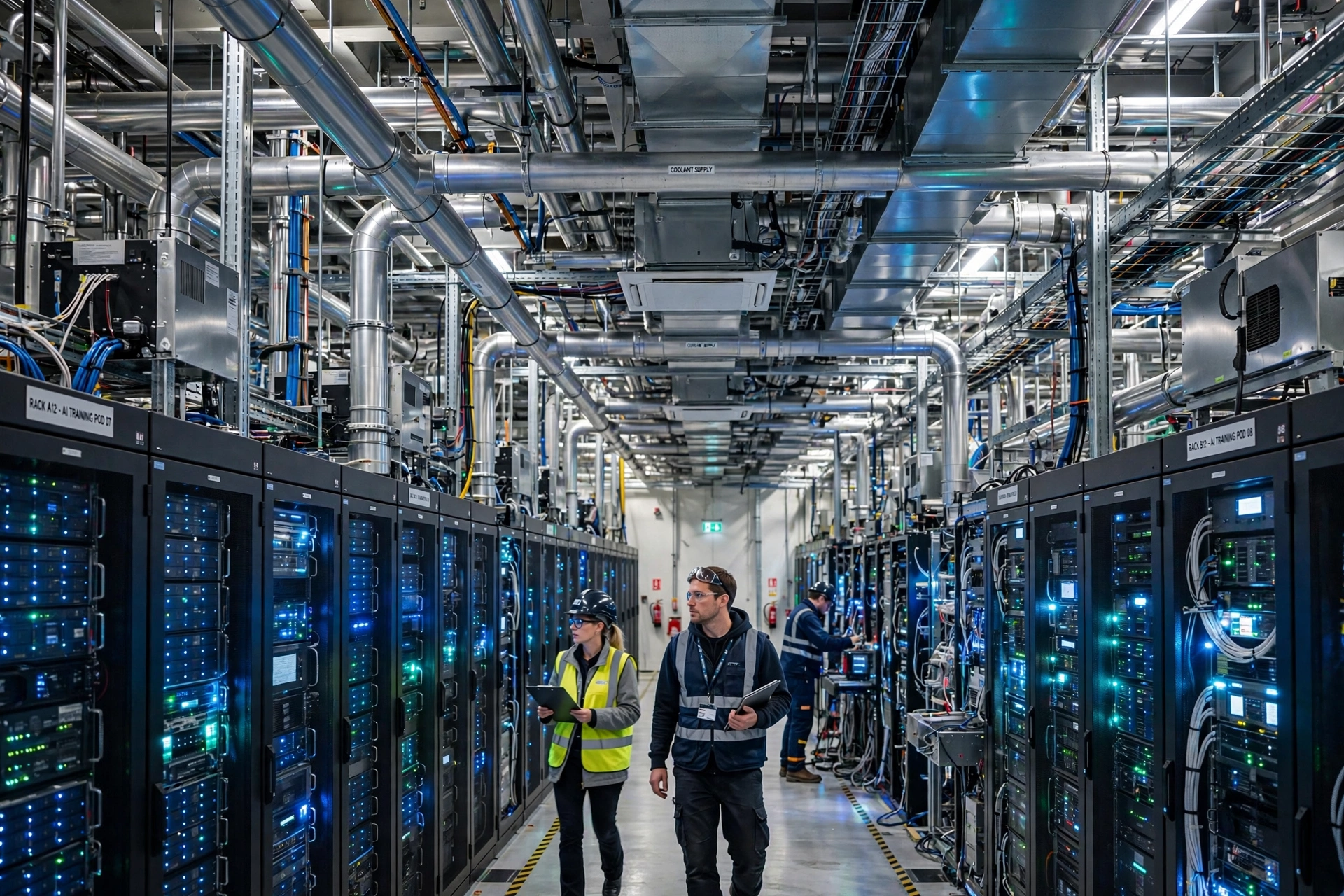
The race to build artificial intelligence data centers has become one of the largest infrastructure build-outs in technology history. Yet a growing body of analysis asks an uncomfortable question: the spending forecasts now appear to outstrip the revenue that AI services are expected to generate in the same period. In short, the AI maths is not adding up as neatly as the construction schedules suggest, and investors, utilities, and governments are starting to notice the gap.
The scale of the build-out
Hyperscale cloud providers and their partners are committing hundreds of billions of dollars to graphics processors, networking, power connections, and new facilities. One widely discussed estimate suggested that paying for AI data centers on the current trajectory would require labour value equivalent to 250 million jobs, in an economy with about 159 million workers. The comparison is deliberately stark, but it underlines how large the capital programme has become relative to the economy meant to support it.
Reporting by The Register on recent forecasts makes the same point from the revenue side: infrastructure spending is forecast to outrun the income expected from AI products over the coming years. Chips are ordered years in advance, power contracts run for decades, and buildings have working lives far longer than the current generation of models.
Where the returns are supposed to come from
The industry case is not irrational. Cloud providers argue that demand for training and inference keeps exceeding supply, that enterprise customers are only beginning to deploy AI at scale, and that whoever owns capacity will own the market. Subscription assistants, coding tools, search features, and automated customer service all need compute every second of every day. If those services become as routine as email, today’s spending could look prescient.
There are also second-order returns. Data centers anchor local construction jobs, grid upgrades, and tax bases, which is why regions compete to host them. Our coverage of whether foldable phones are finally worth buying showed a consumer side of the same cycle: expensive new categories need time, falling prices, and genuinely useful software before the investment feels justified to the people paying for it.
The risks hiding in the gap
Sceptics focus on three risks. First, hardware depreciates fast. Processors bought at premium prices may be overtaken by far more efficient chips within a few years, long before their financing is repaid. Second, efficiency keeps improving: each generation of models and chips tends to deliver more capability per unit of compute, which can reduce the amount of capacity customers actually need to buy. Third, revenue concentration is real. A large share of AI income still comes from a relatively small number of companies, many of them funded by the same investors who fund the infrastructure.
Energy is the other constraint. Analysis collected by the PostQuantum research team and others highlights power as the binding limit: grids, transformers, and generation cannot expand as quickly as server orders. When power is scarce, projects queue, costs rise, and local residents may see higher prices or delayed connections, adding political pressure to the financial kind.
What changes if the maths stays difficult
A correction would not mean AI disappears. It would more likely mean slower construction, tougher questions for marginal projects, cheaper second-hand capacity, and a shift of spending toward efficiency: better chips, better cooling, and software that squeezes more work from existing hardware. Companies with real, paying demand would keep building; speculative capacity would be first to pause. Readers who followed our piece on the strengths and limits of AI assistants will recognise the pattern: the technology is genuinely useful, and usefulness alone does not guarantee that every investment built on it pays back on schedule.
The bottom line
The data center boom is being financed on a forecast, and forecasts deserve scrutiny precisely when everyone agrees with them. If AI revenue accelerates to meet the spending, today’s cranes and server halls will look like the foundation of a new computing era. If it does not, the gap between infrastructure costs and income will force a reset in valuations, construction, and power planning. Either way, the most important number in AI right now is not a model benchmark. It is the distance between what the industry is spending and what its customers are actually paying, and that distance is where the next chapter of the story will be decided.

1 Comment
Pingback: 128 New Moons of Saturn Confirmed as Total Reaches a Record 274 - Ueldo Mesquita