
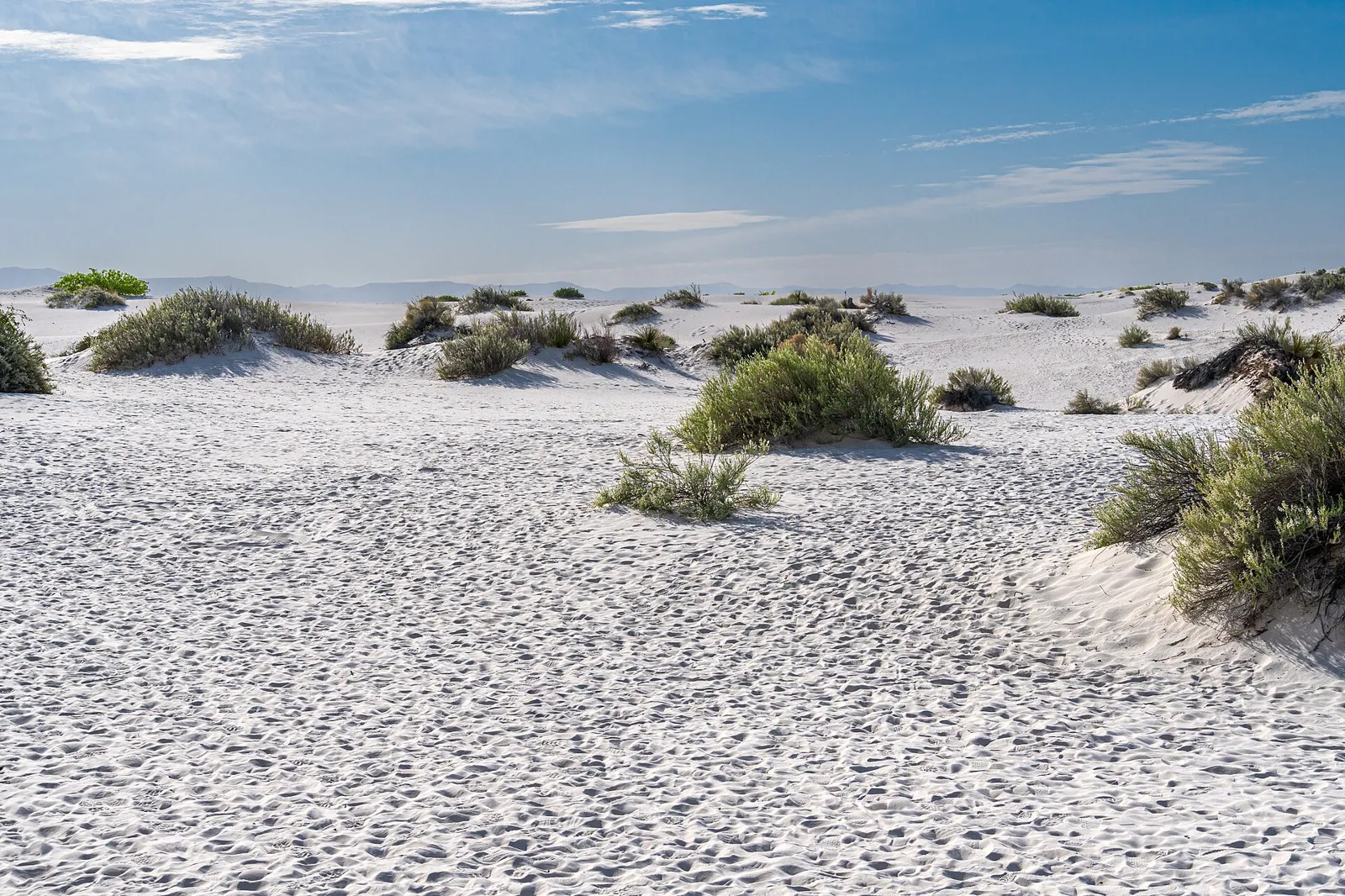
The story of White Sands usually starts with footprints. New research published in Science Advances starts instead with the lake that made those footprints possible, and finds that ancient Lake Otero was restless: its level, chemistry and shores changed abruptly during the Last Glacial Maximum, while people were living alongside it.
Scientists reconstructed the lake from sediment cores extracted from the dried basin floor in the Tularosa Basin of New Mexico. Each core is a vertical archive: layers of mud and gypsum laid down year after year, preserving the fingerprints of the water above them. Dated carefully, the layers become a timeline of environmental change spanning the period of human presence.
Dating a vanished lake
Radiocarbon measurements on organic material in the cores anchor the timeline. Against those dates, researchers read grain size, mineral content and chemical signatures that distinguish deep fresh water from shallow briny pools and dry mudflats. Multiple cores from different parts of the basin let the team watch a single change sweep across the lake system rather than trusting one hole in the ground.
The sequence shows distinct regimes separated by comparatively rapid transitions. The lake did not simply dwindle as the Ice Age relaxed its grip; it alternated, expanding and contracting in steps. The full analysis is published in Science Advances.
Life on a moving shoreline
For the communities around Otero, the lake was larder and landmark: water in a dry basin, fish and birds, reeds and game drawn to the shore. An abrupt shift redrew all of that. Camps that suited one shoreline could be stranded by another, and knowledge had to be updated within a generation. The human tracks at White Sands, adults and children crossing the mudflats, belong to people for whom such flexibility was ordinary life.
That perspective matters for how the site’s famous antiquity is understood. Arriving early was only the beginning; staying required adaptation as a habit. Research that replaces a static backdrop with a dynamic one tends to travel across our science coverage, much as health evidence does in reports like Understanding the Latest Rise in US Measles Cases.
What the cores still hold
Finer dating could soon measure the transitions in centuries or less, and pollen preserved in the mud can name the plants that tracked each shoreline. The team also hopes to correlate Otero’s steps with climate records elsewhere in the Southwest, testing whether the flips were local or regional. White Sands earned fame from a single stratum of tracks; its deeper gift is the whole archive beneath them, a lake’s diary that is still being transcribed.
What the footprints add that sediments cannot
Sediment cores describe a lake; footprints describe a Tuesday. The trails at White Sands capture journeys, a child keeping pace with adults, groups crossing to hunt or gather, journeys interrupted and resumed, and they date those journeys to the same demanding period the cores reconstruct. That combination is exceptionally rare in archaeology, where human evidence and environmental evidence usually arrive in separate trenches, dated by separate methods, and argued over by separate specialists.
It also disciplines interpretation. Knowing that people were demonstrably present while the lake flipped between states rules out the easy story that harsh change simply emptied the basin. Presence through change is itself data: it sets a lower bound on the flexibility of the settlement system, the range of resources people could exploit, and the reliability of the knowledge they passed on. The mud, in other words, testifies about the environment, and the tracks testify back about the people.
Preservation gives the site one more advantage researchers intend to exploit: the gypsum chemistry that saved the footprints also protects organic material in the surrounding sediments unusually well. That raises the prospect of recovering seasonal detail, pollen released in particular springs, flood layers from particular storms, far finer than the century-scale resolution that already transformed interpretation. A record that can speak in seasons as well as centuries would let archaeologists ask how individual years of hardship or plenty were distributed within the longer flips, bringing the reconstruction closer to lived experience than deep-time studies usually manage.
