
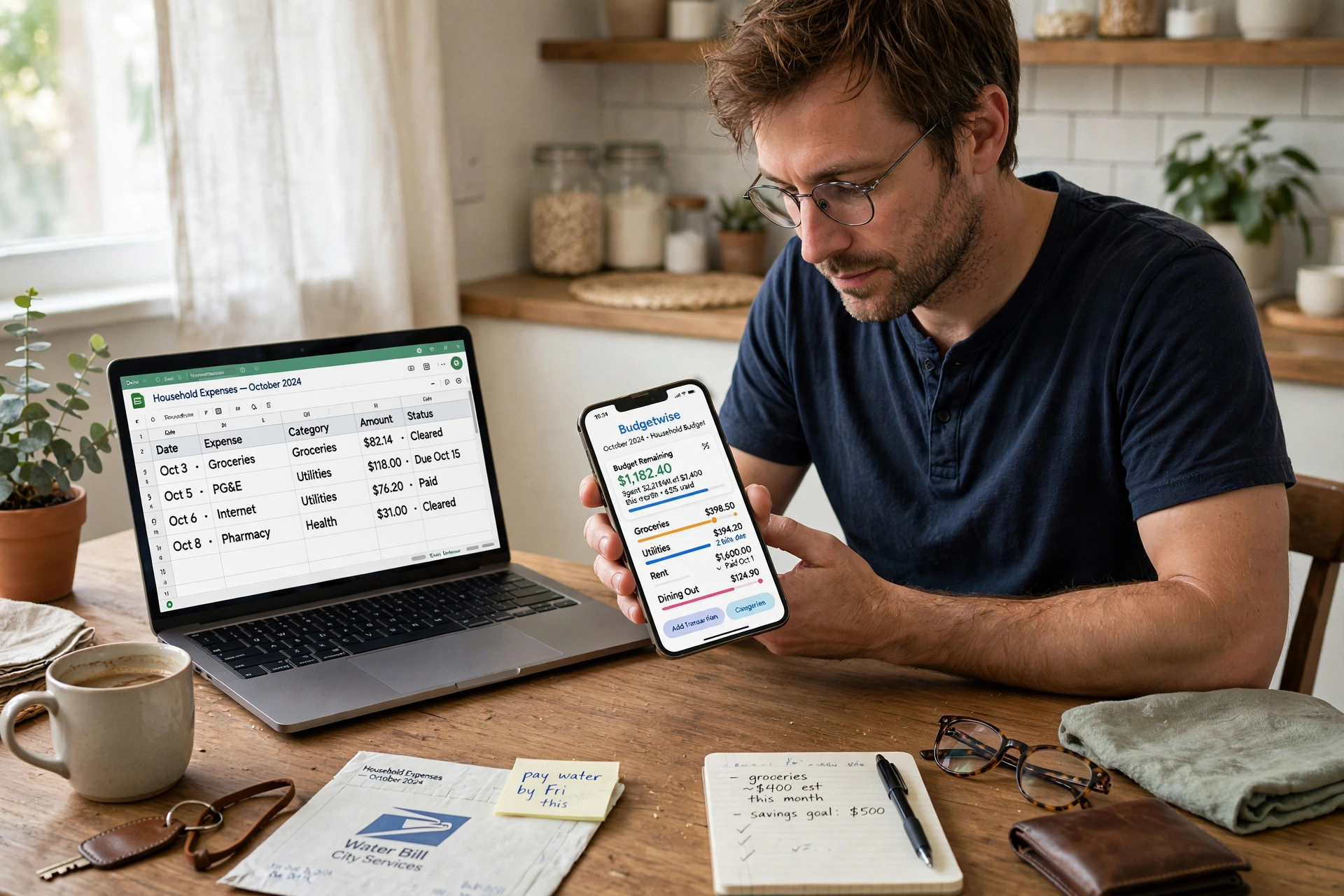
For many households, the monthly budget used to be a rough mental calculation: rent or mortgage, bills, groceries, and whatever was left. Rising prices for essentials have made that informal approach harder to sustain. In its place, a growing number of people are opening an app — one that categorises every purchase, warns when a bill is about to land, and moves small amounts into savings automatically. Budgeting software has moved from a niche habit for money enthusiasts into an everyday household tool.
Visibility Is the First Change
The most immediate effect of a budgeting app is not saving; it is seeing. When spending is sorted automatically into groceries, transport, subscriptions, eating out and household bills, patterns that were invisible in a bank statement become obvious. A handful of small subscriptions, a gradual rise in a weekly shop, or delivery fees that quietly rival the cost of the food itself — these are the kinds of details users consistently say surprised them.
Research on household budgeting behaviour, including work summarised by PYMNTS Intelligence on budgeting tools and financial stress, has found that people who use more advanced budgeting tools are more likely to report feeling financially comfortable than those relying on basic methods alone, even when incomes are under pressure. Visibility does not create money, but it does show where existing money is going.
Automation Takes Willpower Out of Saving
Small, regular transfers
Automatic saving is the feature many households cite as the turning point. Instead of deciding at the end of the month whether anything is left — usually, very little — apps can move a fixed amount the day after payday, round up purchases to the nearest unit and save the difference, or sweep a calculated surplus into a separate pot. The amounts are deliberately small. Their value is consistency: a reserve built in modest increments is easier to maintain than a large transfer that has to be re-decided every month.
The same automation applies to bills. Alerts before a direct debit leaves the account, forecasts that project a balance forward to the next payday, and warnings when spending in a category runs ahead of its usual pace all reduce the chance of an avoidable overdraft or a missed payment. For households juggling irregular income — shift work, freelance payments, seasonal hours — that forward view can be more useful than a static monthly plan.
Read more from our recent coverage: A Practical Content Strategy for Farms, Animal Businesses, and Independent Artists
Why Rising Costs Pushed Apps Into the Mainstream
When prices were stable, an imprecise budget carried little penalty. When food, energy and housing costs move noticeably within a single year, imprecision becomes expensive. Households report using apps to compare their own spending month by month, set caps on discretionary categories, and plan for predictable but irregular costs — insurance renewals, school expenses, car repairs — by setting money aside in labelled pots throughout the year rather than absorbing them in one difficult month.
There is also a household coordination effect. Shared budgets let partners see the same categories and goals, replacing end-of-month reconstructions with a common, current picture. Parents use similar tools to give older children a bounded, visible allowance. None of this requires sophisticated financial knowledge; it requires information presented clearly and updated automatically.
The limits worth keeping in mind
Apps are tools, not solutions. Categorisation can be wrong and needs occasional correction. A forecast is only as reliable as the data behind it, and no app can close the gap when essential costs genuinely exceed income. Users should also pay attention to privacy and fees: connecting bank accounts means sharing transaction data with a provider, so checking how that data is used, whether the service is regulated in their country, and whether a paid tier is actually needed are sensible steps before committing.
Used with those cautions, however, the appeal is easy to understand. Budgeting apps lower the effort of a habit that most people already agree is useful. They make spending visible while it can still be changed, automate the saving decision that willpower often loses, and give households facing rising costs something increasingly valuable: a clear, current picture of their own money.
Read more from our recent coverage: Good Advice Travels: Sharing Useful Ideas Across Agriculture, Animals and Art
