
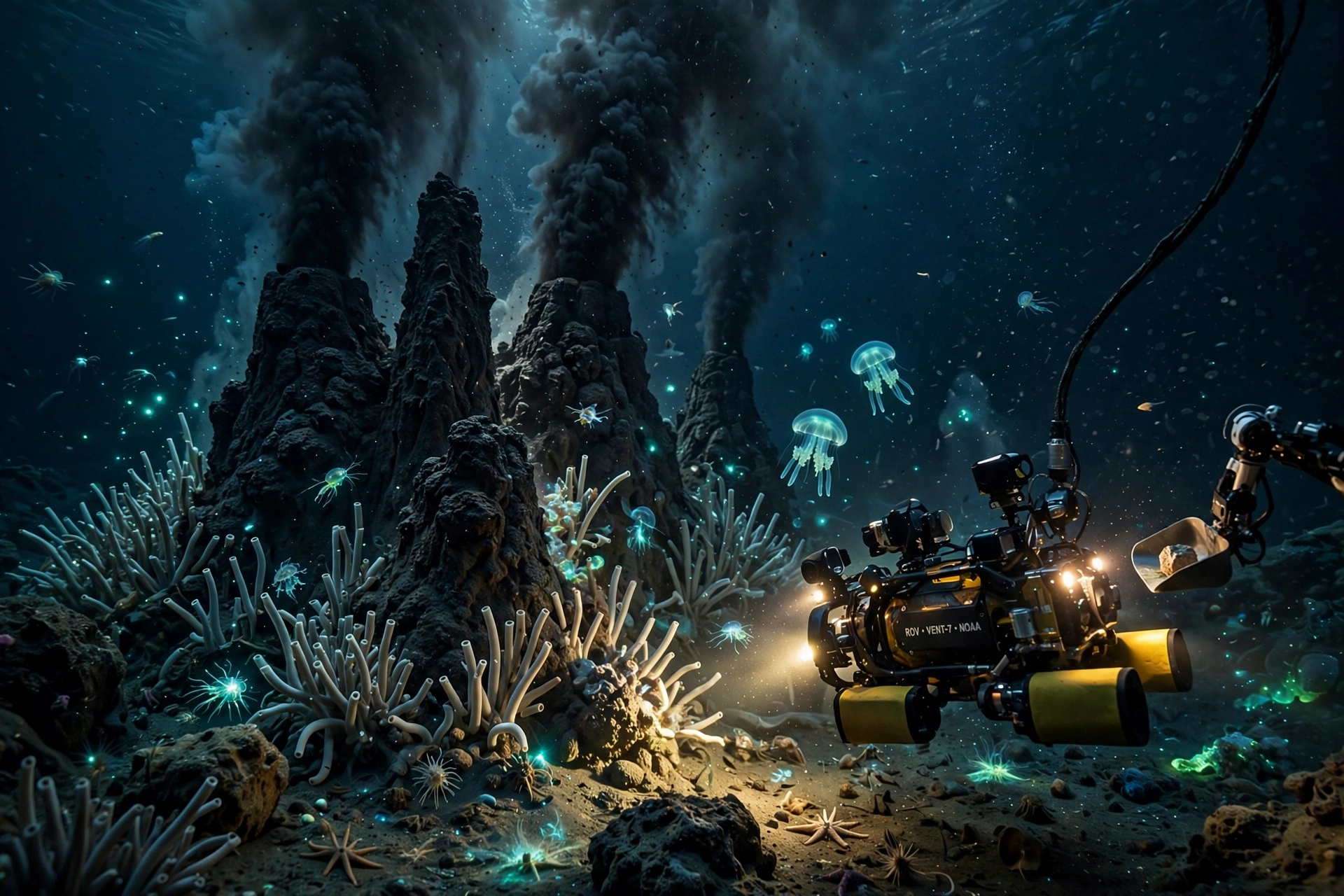
Far below the reach of sunlight, in water that is near freezing and under pressure that would crush ordinary equipment, life is not merely surviving — it is flourishing in forms scientists are only beginning to catalogue. Every major deep-ocean expedition in recent years has returned with species never seen before, habitats no textbook described, and questions that reach far beyond marine biology. The deep sea, long treated as a quiet and largely empty frontier, is emerging as one of the most dynamic environments on Earth.
A World That Runs Without Sunlight
The turning point in modern understanding came with the discovery of hydrothermal vents — cracks in the seafloor where superheated, mineral-rich water pours out of the crust. Around those vents, entire communities thrive without photosynthesis. Bacteria convert chemicals such as hydrogen sulphide into energy through chemosynthesis, and that microbial foundation supports tube worms, shrimp, crabs, mussels and fish found nowhere else. Research programmes described by NOAA’s hydrothermal vents research have shown how vent systems discovered around volcanic arcs and mid-ocean ridges continue to reveal new ecosystems and new species.
What surprises researchers most is the pace of discovery. A single survey of a previously unmapped ridge can document dozens of unfamiliar animals, from translucent sea cucumbers and ghostly fish to bristle worms adapted to water laced with metals. Some species appear to live only around one vent field, which means the loss of a single site could erase a species before it has even been named.
New Species, New Questions
Adaptations that challenge biology
Deep-sea animals cope with darkness, cold, scarce food and immense pressure. Many produce their own light through bioluminescence, using it to attract prey, confuse predators or communicate. Others have evolved slow metabolisms and long lifespans, growing over decades or even centuries. Studying how their proteins and membranes function under pressure is giving biochemists clues that may eventually inform medicine and materials science, although researchers are careful to say those applications remain distant possibilities rather than promises.
Genetic analysis has added another layer of surprise. Animals that look almost identical on camera sometimes turn out to be distinct species, while populations separated by thousands of kilometres of ocean floor can be closely related, carried by currents in larval stages. Mapping that connectivity matters: it helps scientists understand how resilient deep ecosystems might be if a vent goes dormant, a slope collapses, or human activity disturbs the seabed.
Read more from our recent coverage: Maan Win Register – Simple Guide for First-Time Users
The Technology Opening the Abyss
None of this would be visible without a quiet revolution in exploration technology. Remotely operated vehicles now carry high-definition cameras, robotic sampling arms and chemical sensors to depths of several thousand metres, streaming live images to scientists on ships — and sometimes to classrooms on shore. Autonomous underwater vehicles can map terrain overnight, building detailed charts of ridges, seamounts and trenches that ships then investigate in daylight.
Improved sonar, environmental DNA sampling and long-term seafloor observatories are changing the work again. Instead of a brief visit, researchers can now watch a vent field change over months, detect species from traces of DNA in a bottle of seawater, and revisit exact locations with centimetre-level precision. Each improvement lowers the cost of asking better questions.
Why the discoveries matter on land
The deep ocean regulates climate, stores carbon and drives nutrient cycles that support fisheries closer to the surface. Understanding its ecosystems is therefore not an academic luxury. As interest grows in deep-seabed minerals, scientists argue that baseline knowledge must come first: you cannot assess the impact of disturbing a habitat that has never been surveyed. The same expeditions finding new species are also producing the maps and records that policymakers need.
There is also a simpler reason the discoveries resonate. They are a reminder that exploration is not finished. On a planet whose land surface has been photographed in exhaustive detail, the largest habitat on Earth still yields new life on almost every serious visit. The next generation of vehicles, sensors and international surveys will almost certainly expand the catalogue further — and, if recent history is a guide, rewrite parts of it again.
Read more from our recent coverage: A Practical Content Strategy for Farms, Animal Businesses, and Independent Artists
For now, the message from the abyss is consistent: the deep sea is richer, stranger and more connected to the rest of the planet than scientists assumed a generation ago, and each dive makes the old picture look incomplete.
